
Pipeline mandate rejected by separatists members. Grievance politics, pandering to continue for now.

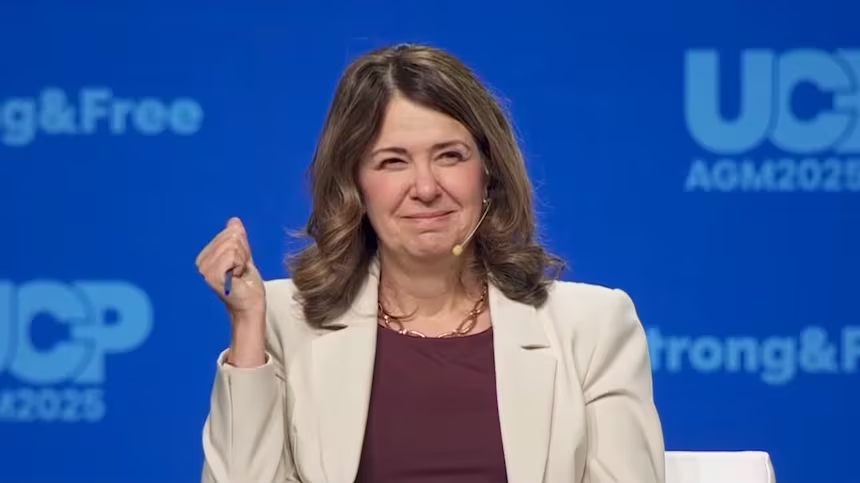
Premier Danielle Smith’s weekend began with a grand bargain in the bag and ended with a familiar balancing act. Fresh off signing a memorandum of understanding with Ottawa hailed as a breakthrough for Alberta’s energy sector, she walked into the United Conservative Party’s annual general meeting with renewed support from Alberta’s energy sector and business community only to be booed by members in response to her claim that the MOU provided proof that Canada can work.
This year’s AGM captured the paradox of Smith’s leadership: A premier who secured a national deal yet continues to lean on grievance politics to keep herself as leader and to keep the party together.
On Friday, Smith’s suggestion that the MOU was proof Canada can work for Alberta was greeted with a chorus of boos, and pro-separation sentiment expressed by Jeff Rath of the Alberta Prosperity Project that followed drew loud cheers.
Smith has long relied on the separatist faction as leverage for achieving her political agenda, and the anti-Ottawa support expressed on the first day of the United Conservative Party’s annual general meeting underscores the tension she manages inside her party.
By Saturday she was back on script, perhaps carrying the confidence of her MOU victory into the near‑term battles her party faces. During her keynote address, Smith reaffirmed her party’s commitments to social conservatism as well as Alberta sovereignty, including reasserting protections for children, referencing her government’s overhaul of health care, announcing that the province would take primary control of immigration, and outlining a plan to block provincial municipalities and law enforcement agencies from cooperating with federal firearm “seizures” (also known as the buyback program).
The tone of her performance suggested she may have an appetite to confront the recall petitions facing 14 of her MLAs head-on. She may be preparing to amend recall legislation itself to protect them rather than letting these efforts play out and accepting the outcomes, or shuffling her cabinet to remove political albatrosses and replace them with relative moderates.
In the lead-up to striking a deal with Ottawa, the separatist wing of the UCP had value: Ottawa could see louder, more extreme voices behind her, and that pressure, combined with federal political realities and industry interests, helped create the conditions for a deal. But post-MOU signing, the separatist element is a risk.
The MOU clears a major political hurdle, but a new pipeline to British Columbia’s north coast still requires public legitimacy, investor confidence, Indigenous partnership, and the cooperation of federal regulators through formal review and approval processes. Rhetoric that questions Confederation itself swings against all of those outcomes.
The UCP AGM underlined this problem. The anti‑federal voices in the room showed that the faction Smith used to help secure the MOU is still loud, mobilized, and their behaviour has the potential to shape the public face of the party. Such displays may energize parts of the UCP base, but they make it harder for the government to project the stability and credibility needed to move a pipeline forward. You cannot claim to be building long‑term national cooperation while members of your own party argue the country itself is beyond repair.
Smith would have difficulty turning her back on the separatist faction without risking party collapse. They represent a significant portion of the party, one that enthusiastically volunteers and organizes party activities.
The path forward is narrow but workable for Smith. She must keep separatist voices close enough to avoid a formal break while steadily neutralizing their influence over the party’s narrative. This will be difficult with a referendum question on the horizon.
The path forward is narrow but workable for Smith. She must keep separatist voices close enough to avoid a formal break while steadily neutralizing their influence over the party’s narrative. This will be difficult with a referendum question on the horizon.
Shifting her party’s narrative from grievance to vision may be a bridge too far. Smith’s rhetoric about unleashing Alberta’s energy shifted in her keynote when she returned to putting UCP detractors on notice, pointing her finger at the various elements getting in the way of her members living strong and free.
Sovereignty is not separation, but it sits on the same spectrum of anti‑Ottawa politics and serves her in the short term. As long as progress on the pipeline remains slow or symbolic, she can continue tapping resentment without paying the price of having it detract from the conditions required to get a pipeline built. It keeps her base engaged, keeps the Alberta-versus-Ottawa frame alive, and allows her to claim both that she secured an MOU and that she still has to fight Ottawa on behalf of her members. In that scenario, grievance remains useful.
That would explain why she has not rushed to discipline or distance herself from the separatist wing. It still serves the purpose. It reinforces the idea that Alberta is being held back, and that she is the one standing between the province and a federal government that cannot be trusted.
The purpose of the UCP AGM was to celebrate party achievements and work through issues in order to shore up unity and continue progress on the party’s agenda. Smith appears to have succeeded. If her performance at the AGM is any indication, Albertans can expect an emboldened premier in the days and weeks ahead. The UCP government’s familiar tack of ploughing ahead with their agenda despite intense criticism is likely to continue.
Leave a Reply