
Alberta separation
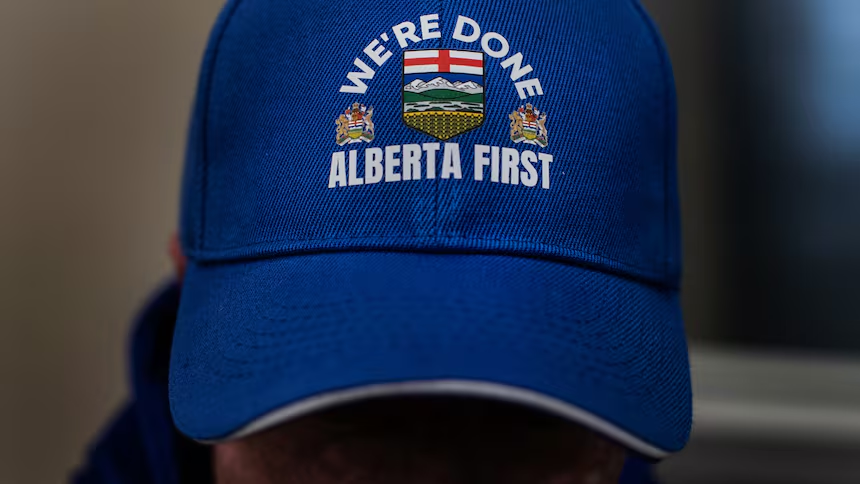
January marked a significant escalation in Alberta’s separatist movement with the launch of a citizen-initiated petition seeking a referendum on whether Alberta should separate from Canada and become an independent country. What had largely been a rhetorical and protest-driven movement has now entered a formal process overseen by Elections Alberta.
Summary
Elections Alberta formally issued a citizen-initiated petition seeking a referendum on Alberta separation on early January 2, 2026.
Organizers must collect 177,732 verified signatures by May 2, 2026, for a referendum to proceed.
A referendum, even if successful, would not itself result in separation but would trigger complex constitutional negotiations and investment decisions.
Why this matters
Alberta’s separation petition process, beginning with a petition campaign and potentially advancing to a referendum, introduces political and economic uncertainty that markets and stakeholders should monitor, even in the absence of immediate legal or regulatory change.
Questions around future governance, taxation, trade rules, federal program access, and interprovincial market stability can influence how investors and lenders assess risk, and while Alberta’s institutions and near-term operating environment remain stable, experience shows that confidence effects can emerge early through delayed investment, adjusted risk premiums, and heightened scrutiny, intensifying as the process moves closer to a referendum and credible scenarios of constitutional change enter market expectations.
Launch of separation referendum petition
On January 2, 2026, Elections Alberta issued a citizen initiative petition titled A Referendum Relating to Alberta Independence, after determining the application met all legislative requirements under Alberta’s Citizen Initiative Act.
The approved referendum question reads:
“Do you agree that the Province of Alberta should cease to be a part of Canada to become an independent state?”
Under provincial law amended last year, organizers have 120 days (January 3 to May 2, 2026) to collect 177,732 verified signatures, representing 10 per cent of ballots cast in the last provincial election (May, 2023). Only signatures gathered in person by registered canvassers will be accepted.
Signature collection underway
Organizers have launched a province-wide signature drive, holding rallies and petition events in both urban and rural communities. Media coverage has documented large turnouts at events in Calgary and other centres, with sustained early momentum as the campaign enters its second month.
While early participation has been visible, Elections Alberta has emphasized that all signatures will be subject to strict verification requirements before any threshold determination is made.
Key players
Stay Free Alberta is playing an operational role in the separation petition effort by organizing rallies and public signing events, and mobilizing its grassroots network to collect signatures.
The Alberta Prosperity Project (APP) is a non‑profit organization that describes its purpose as educating Albertans about economic, governance, and provincial autonomy issues, and promoting discussion of various policy options — including, among others, the possibility of an independence referendum.
Political response and public debate
The political response has been marked by sharp divisions, with the Alberta government emphasizing the separatists’ right to advance their aim while the opposition NDP, other provincial premiers and federal leaders warn that the initiative risks economic instability and national cohesion. Public debate has intensified accordingly, splitting between those who view the petition as a legitimate expression of grievance and those who see it as a destabilizing distraction.
United Conservative Party (UCP)
Premier Danielle Smith has stated she is a federalist and supports a “sovereign Alberta within a united Canada.” While her government amended legislation governing citizen-initiated referenda to signifcantly reduce barriers to a successful referendum, Smith has not publicly endorsed separation. Critics argue that accommodating separatist factions within the UCP has contributed to the movement’s growth.
Alberta New Democratic Party (NDP)
The Official Opposition has adopted a confrontational stance, launching a pledge campaign urging MLAs to publicly reject separatism and framing the issue as a defining political choice for the province.
Public Opinion
Recent polling reported by major Canadian outlets suggests support for independence remains a minority position, with roughly three in ten Albertans expressing openness to separation, and significantly lower support when economic and legal consequences are considered.
International attention, domestic disruption
U.S. Treasury Secretary Scott Bessent said Alberta’s resource wealth makes it “a natural partner” for the United States, comments that helped draw attention to the province’s internal political debate. International outlets such as the Financial Times have reported that representatives of Alberta separatist groups have met multiple times with U.S. State Department officials, noting Alberta’s economic significance and its discussion around an independence question.
Canadian political leaders, including British Columbia Premier David Eby, publicly criticized these reported contacts as inappropriate involvement by a foreign government. This sequence of commentary and reporting illustrates how a provincial separation debate has begun to generate visibility and discussion beyond Alberta and Canada.
Legal and Constitutional Reality
Even if the petition threshold is met and a referendum is held, a successful referendum would not itself alter Alberta’s constitutional status. Any move toward independence would require:
- Negotiations with the federal government
- The participation of other provinces
- Compliance with Canada’s constitutional framework, including the principles set out by the Supreme Court of Canada on secession
This distinction has been emphasized by constitutional experts and acknowledged by Elections Alberta in its public materials.
Outstanding Policy Gaps
To date, proponents of independence have provided limited detail on how an independent Alberta would function in practice. Key unanswered questions include:
- Constitutional and legal structures
- Fiscal policy, debt, and revenue arrangements
- Currency and monetary policy
- Trade access and market continuity
- Institutional capacity during transition
Analysts note that the absence of clear policy proposals could become a central challenge as the petition advances toward its signature target and a referendum campaign.
Key issues
Economic and Investment Risk Signals
Even the prospect of a referendum is sending cautionary signals to investors. Uncertainty around constitutional stability, market access, currency, and regulation risks delaying capital decisions, particularly in energy, infrastructure, and finance. Prolonged ambiguity may have consequences regardless of whether a referendum ultimately proceeds.
Clash with First Nations
Alberta’s separation movement is now in direct conflict with First Nations whose treaty and constitutional rights pre‑date the province and cannot be overridden by a provincial referendum. As separatists advance a citizen‑initiated process claiming democratic mandate, Indigenous governments assert that Alberta cannot leave Canada without their consent because treaties were signed with the Crown, not the province. This clash between separatist claims and constitutionally protected treaty rights has transformed the separation debate into a broader confrontation over sovereignty, jurisdiction, and who holds the authority to decide Alberta’s future.
Rising criticism and political backlash
Premier Smith continues to describe herself as a federalist, but her position is under increasing strain. Critics argue that her accommodation of separatist voices within her governing coalition, combined with legislative changes that lowered the barriers for citizen-initiated referenda, has helped legitimize a movement now generating national and international backlash. As foreign commentary and negative headlines amplify the issue abroad, Smith faces growing pressure at home, from moderates concerned about economic risk, from federalists alarmed by national unity implications, and from First Nations who see separatism as a direct challenge to their legal standing.
Additonal background
A citizen initiative petition opposing Alberta separation, led by Thomas Lukaszuk, ran from July 30 to October 28, 2025. Elections Alberta completed verification on November 15, 2025, confirming 404,293 valid signatures—well above the required 293,976—and later posted the approved result publicly on December 1, 2025. Although the petition demonstrated broad public opposition to separation, the Citizen Initiative Act requires only that a successful policy‑proposal petition be forwarded to the Legislative Assembly. It does not obligate the government to pass legislation, call a referendum, or replace the separatist referendum question already underway, raising debate over whether the process adequately reflects majority public sentiment on a high‑stakes constitutional issue.
What to Watch
Signature momentum
Whether organizers can maintain sufficient pace to meet the May 2, 2026, deadline under strict verification standards.
Business community positioning
Major corporate and investment voices have largely stayed silent despite the imminent threat a referendum process poses to investment in the province. Continued momentum could prompt clearer public positions, particularly from business and industry leaders.
UCP internal dynamics
How Premier Smith manages competing pressures within her governing coalition while maintaining a federalist stance.
Federal Response
Ottawa has so far avoided direct engagement. A verified petition could require more explicit federal messaging on economic and constitutional implications.
Market Sensitivity
Investors are closely monitoring political risk signals. Even the prospect of a referendum may affect capital allocation decisions and project timelines.
Related Links
Elections Alberta
https://www.elections.ab.ca/recall-initiative/initiative/current-initiative-petitions/
Ipsos polling on separation in Canada (released January 23, 2026)
https://www.ipsos.com/en-ca/support-independence-alberta-reaches-levels-similar-quebec
Curated media
Jan. 15, 2026: Opinion: Time for Smith to stop placating Alberta separatists?
Dec. 7, 2026: ‘People are upset’: What Alberta’s anti-separatist worries about now
Sept. 26, 2025: Alberta separatists should be careful what they wish for